
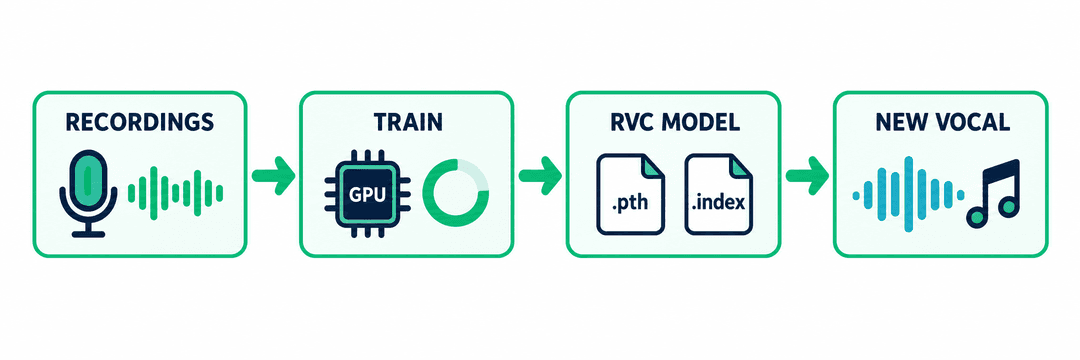
Short answer: An RVC model is a small AI voice model made with Retrieval-based Voice Conversion (RVC), an open-source method that changes the voice in a recording while keeping the words, melody and timing. A trained RVC model usually comes as two files: a .pth file with the voice weights and an optional .index file that helps the output sound closer to the original speaker or singer. You train one from a few minutes of clean recordings of a single voice.
In AI music, "RVC" almost always means this voice conversion model, and "RVC voice cloning" means training one on a particular voice. A large share of the AI cover songs shared online were made with it.
What does RVC stand for?
RVC stands for Retrieval-based Voice Conversion. The RVC-Project released it publicly in 2023 under the MIT license. It became one of the most widely used open-source voice conversion workflows because it runs on consumer NVIDIA graphics cards and often needs less training audio than older approaches.
"Voice conversion" is the key part. RVC does not write lyrics or compose music. It takes an existing vocal performance and re-voices it: the source singer's phrasing, pitch and rhythm stay, and the tone of voice becomes the voice the model was trained on.
What is an RVC voice converter and how does it work?
An RVC voice converter is any tool that loads an RVC model and runs a recording through it. In plain terms, it does three things to every vocal it converts:
Separates what is sung from who sings it. A speech model (HuBERT / ContentVec) turns the input vocal into features that describe the sounds being made, mostly independent of the singer's identity.
Tracks the pitch. A pitch extractor (RMVPE is the common choice; Crepe and Harvest are alternatives) follows the melody, so the converted voice hits the same notes. You can shift it by an octave for male-to-female or female-to-male conversion.
Rebuilds the audio in the target voice. The trained generator turns those features and that pitch back into sound with the target speaker's timbre.
The "retrieval" in the name is the optional extra step in the middle: before rebuilding, RVC looks up the most similar sounds from the training recordings (stored in the .index file) and nudges the features toward them. That can pull the output closer to how the target voice really sounds.
Conversion is a strong approximation, not a perfect copy: depending on the source vocal and the model, you can still hear pitch wobbles, slurred consonants or breathy artifacts.
What are the .pth and .index files in an RVC model?
When people share or sell "an RVC model", they mean these files, usually in one zip:
| File | What it is | Typical size (RVC v2) | Required? |
|---|---|---|---|
| .pth | The trained voice weights: the part that actually "is" the voice | Often around 55 MB | Yes |
| .index | A searchable index of features from the training audio, used for retrieval | From about 15 MB to several hundred MB | No, but commonly included |
Exact sizes vary with the sample rate, the training tool and how many feature vectors the index keeps. The .index file is optional. Without it, conversion still works and uses the .pth alone. With it, an "index rate" setting controls how strongly the output is pulled toward the training voice. Raising it can make the result closer, but it can also add muffled or tinny artifacts, especially if the training audio was noisy, so it is a balance rather than "higher is better".
The index can be much larger than the weights. In our own test, training on about 15 minutes of separated vocals produced a 136 MB index next to a 55 MB .pth, plus a 132 MB total_fea.npy working file that the training scripts leave behind and inference never uses.
What's the difference between RVC v1 and RVC v2?
RVC v2 is the version almost everyone uses now. It extracts richer 768-dimensional features from the input (v1 used 256), which generally gives clearer, more natural results, especially on singing. Models are trained at 32, 40 or 48 kHz; 48 kHz is the usual choice for music.
A v1 model and a v2 model are not interchangeable. Conversion tools need to know which version a .pth file is, and most actively maintained tools are built around v2.
Where do RVC models come from?
There are two sources:
Shared models. Community sites and repositories host thousands of RVC models, many of them imitating real singers, actors or characters. Most are uploaded without the voice owner's permission, licenses are often unclear, and some files are training checkpoints rather than usable inference models. Treat them with caution, especially for anything you plan to publish.
Models you train yourself. Training on your own voice, or a voice you have clear permission to use, avoids those problems. It is also the only way to get a model of a voice nobody has published.
If you want to sing covers in someone else's voice, our guide to making an AI cover song legally covers the consent and copyright questions in more detail.
How do you train an RVC model?
Every RVC training setup follows the same steps:
Collect clean audio of one voice. Somewhere between 5 and 15 minutes of singing (or speech) usually works. More variety (low, middle and high notes) matters more than more minutes.
Remove everything that isn't the voice. Backing music, reverb, harmonies and other singers all get learned as part of the voice. A vocal remover helps when all you have are finished songs.
Slice and preprocess. The audio is cut into short segments, silence is dropped, and pitch and features are extracted.
Train for a set number of epochs. One epoch is one pass over the training audio. More epochs take longer and give diminishing returns.
Build the index and export. The result is the .pth file plus the .index file.
Where can you run it?
| Option | What you need | Good for | Watch out for |
|---|---|---|---|
| Local RVC WebUI (or forks like Applio) | A recent NVIDIA GPU, Python setup, disk space | Full control, no per-run cost | Setup time, driver issues, tuning dozens of settings |
| Google Colab notebooks | A Google account, often a paid plan for steady GPU access | No local GPU | Sessions disconnect; notebook and policy changes break things; check current Colab terms |
| Developer APIs (for example Replicate's train-rvc-model) | An API account and a way to package the dataset zip | Building training into your own app | You handle file prep, webhooks and storage yourself |
| Paid training services | Someone else's time | One-off models | Turnaround, privacy of your recordings, quality varies |
| Online trainers like RaoMusic | A browser and your recordings | Training without a GPU or setup, then using the voice right away | Costs credits per training run |
Can you train an RVC model online for free?
Partly. The RVC software is free and open source, so training on your own computer costs nothing beyond the hardware and electricity, if you have a capable NVIDIA GPU. Free online options are less dependable: free Colab GPU time is limited and sessions can disconnect mid-training, community notebooks break when dependencies change, and free tiers of training APIs (where they exist) come with quotas. Training needs GPU time, so stable online trainers, including RaoMusic, charge for it. If "free" matters most, local training is the realistic route; if you have no GPU or don't want the setup, an online trainer saves you that time.
How to train an RVC voice model online with RaoMusic
RaoMusic's AI voice cloning runs the whole pipeline above in the browser:
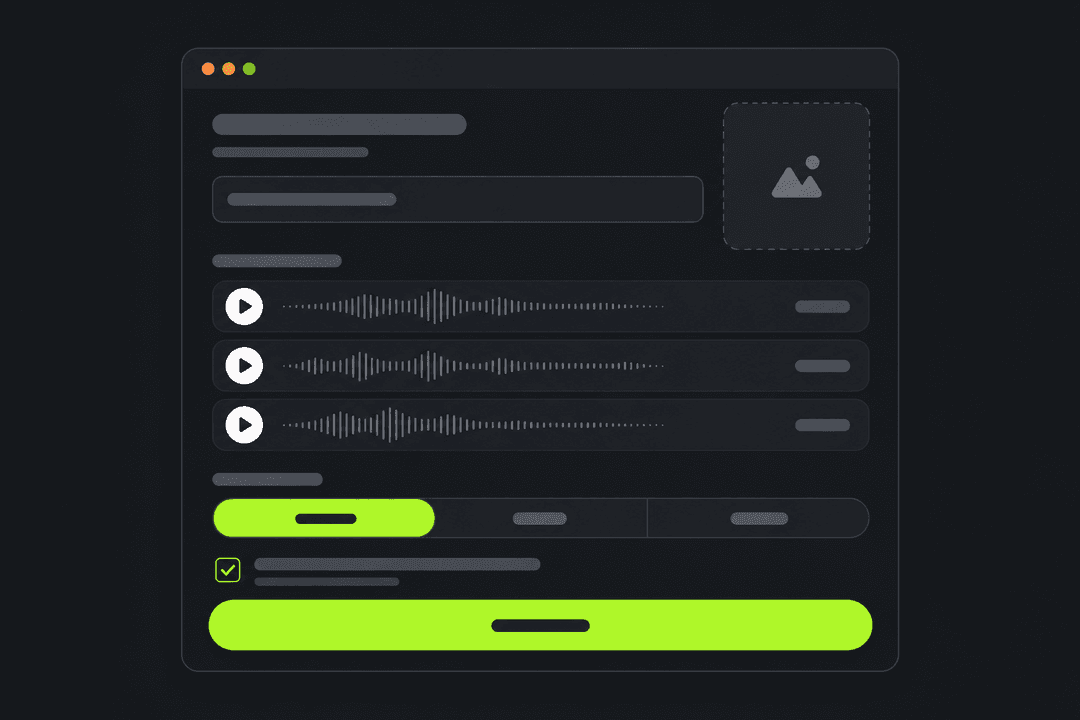
Add 8–15 minutes of your own singing. Upload files or pick songs from your library. Backing music is removed automatically, and silence is trimmed.
Pick a training quality. Standard (50 epochs), High (100) or Max (150), for 150, 250 or 350 credits. If less than 3 minutes of clear singing is left after separation, or training fails, the credits are refunded automatically.
Wait about 15–40 minutes. Training is a standard RVC v2 setup: 48 kHz with RMVPE pitch extraction. You can close the page.
Listen, use and download. When it finishes, a short sample is sung in your new voice. The voice then appears under "My voices" in the AI cover song generator, and you can download the model as a zip with the .pth and .index files to use in other RVC tools.
Training is not free: each run costs credits, because it uses rented GPU time. What you get in return is no GPU, no Python, and no file preparation.
How many epochs should you train an RVC model?
We trained the same voice twice to find out. The source was a consistent AI-generated singer (our virtual artist JUNO), and we converted the same test song with each model:
| Test | Training audio | Epochs | GPU time |
|---|---|---|---|
| Run 1 | About 24 minutes of full songs, backing music left in | 100 | About 29 minutes |
| Run 2 | About 15 minutes, vocals separated first | 50 | About 9 minutes |
In a side-by-side listen, the 100-epoch model sounded slightly closer, but the difference was small. That is why 50 epochs is our default and why the higher tiers are optional. The two runs also differed in training audio, and this is one test with one voice, so treat it as a data point, not a rule. In general, clean training audio matters more than extra epochs, and very high epoch counts can overfit a small dataset.
Does the RVC .index file make a difference?
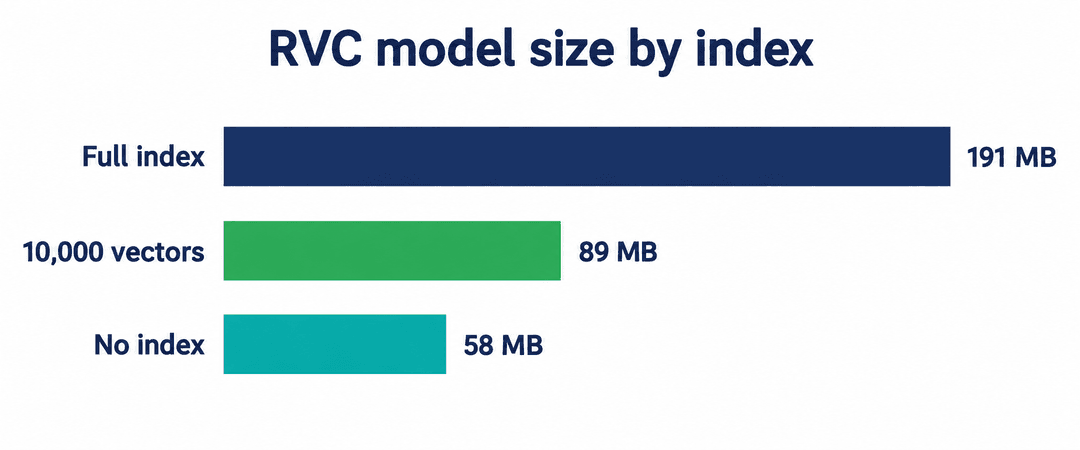
The index is the biggest part of an RVC model, so we tested whether it can be shrunk. Using the 50-epoch model, we rebuilt the index from about 45,000 feature vectors down to 10,000 cluster centers, using the same clustering approach RVC itself uses for large datasets:
| Version | Model zip size | Result in our listening test |
|---|---|---|
| Full index (45,162 vectors) | About 191 MB | Reference |
| Index shrunk to 10,000 vectors | About 89 MB | Could not hear a difference |
| No index (.pth only) | About 58 MB | Could not hear a difference |
In this test the index made no obvious audible difference, and raising the index rate on the 10,000-vector version didn't change what we heard either. That was a clean, consistent AI-generated voice; human recordings with more noise and variation may behave differently, so don't treat it as a universal rule. RaoMusic keeps a 10,000-vector index in every trained model as a middle ground: about 90 MB at most, no matter how much audio you upload.
Common RVC training mistakes
Training on finished songs without removing the music. The model learns the band along with the voice.
Mixing several singers. Duets, harmonies and featured artists blur the voice into an average of everyone.
Too little range. If every clip is quiet and low, high notes will sound strained after conversion.
Chasing epochs instead of fixing audio. Ten minutes of clean vocals beats thirty minutes of noisy ones, and more epochs will not fix bad data.
Expecting a technique transplant. RVC copies tone, not skill. A cover keeps the original singer's vibrato, runs and phrasing.
Frequently Asked Questions
An RVC model is an AI voice model made with Retrieval-based Voice Conversion. It changes the voice in an existing recording into the voice it was trained on, keeping the words, melody and timing. It usually consists of a .pth weights file and an optional .index file.
The .index file stores features from the training recordings. During conversion, RVC searches it for the closest matching sounds and pulls the output toward them, which can make the result sound closer to the target voice. Conversion still works without it.
The RVC software is free and open source, so local training is free if you have a capable NVIDIA GPU. Free online options such as Colab notebooks are limited and can disconnect or break. Stable online trainers charge for GPU time; on RaoMusic, each training run costs credits, with an automatic refund if training fails.
Most setups work with about 5 to 15 minutes of clean audio of one voice. RaoMusic asks for 8 to 15 minutes of uploads so that at least 3 minutes of clear singing remains after the backing music is removed.
There is no single right number. In our test, 100 epochs sounded only slightly better than 50 on the same voice, so 50 is a sensible starting point. Cleaner training audio usually helps more than more epochs.
Usually, yes. Trained voices download as a zip with an RVC v2 (48 kHz) .pth file and a .index file, which load in most RVC v2 voice converters. Compatibility depends on the other tool's version and settings, so test it there before relying on it.
RVC v2 extracts richer features from the input audio than v1, which usually gives clearer and more natural results, especially for singing. The two versions are not interchangeable, and most current tools expect v2.
Training a model of your own voice is fine. Cloning someone else's voice without permission can raise right-of-publicity, consent and platform-policy problems, and publishing songs made with it adds copyright questions. Only clone voices you own or have permission to use.